Latest Posts

Efficiency Meets Quality: Google & JHU Pioneers Conditional Diffusion Distillation in Just 1-4 Sampling Steps

In a new paper Conditional Diffusion Distillation, a research team from Google Research and Johns Hopkins University introduces an innovative framework that distills an unconditional diffusion model into a conditional one, enabling image generation with significantly fewer steps.

The Reversal Curse: Uncovering the Intriguing Limits of Language Models

In a new paper titled “The Reversal Curse: LLMs trained on ‘A is B’ fail to learn ‘B is A'” authored by a collaborative research team from Vanderbilt University, the UK Frontier AI Taskforce, Apollo Research, New York University, the University of Sussex, and the University of Oxford, has unveiled a remarkable shortcoming in auto-regressive large language models (LLMs).

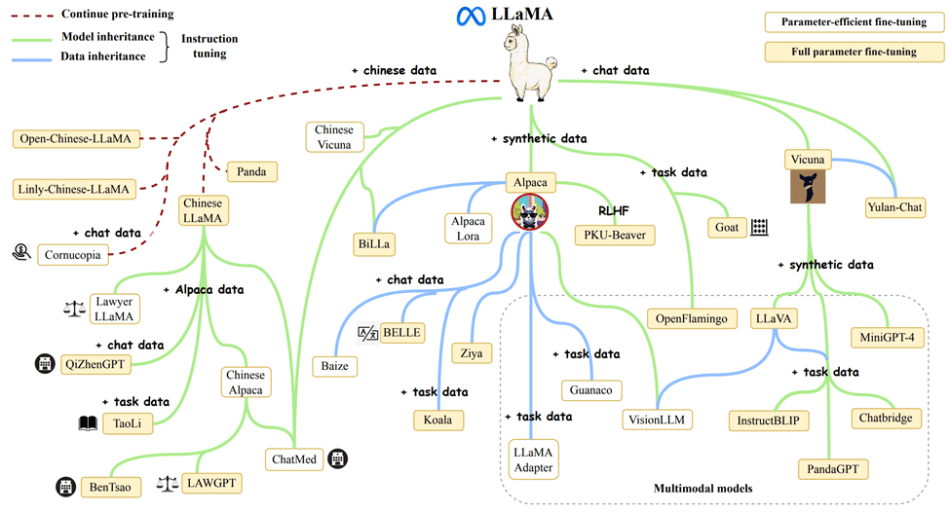
One half-day of training using a few hundred dollars yields similar results to mainstream large models, open-source and commercial-free domain-specific LLM solution

Being at the forefront of cost reduction and efficiency enhancement for large models, the Colossal-AI team maximizes the core capabilities of LLaMA-2. Through innovative training techniques, Colossal-AI has achieved remarkable results by utilizing only approximately 0.0085 trillion tokens of data, investing 15 hours, and incurring training costs in the range of a few hundred dollars.

Equall & Apple’s Revolutionizing Transformers: One Wide Feedforward for Unprecedented Efficiency and Accuracy

A collaborative research effort from Equall and Apple delves into the role of the FFN and uncovers a surprising revelation: despite consuming a significant portion of the model’s parameters, the FFN exhibits high redundancy. As a result, the researchers propose sharing a single FFN across both the encoder and decoder, thereby reducing the parameter count while causing only a modest drop in accuracy.

CMU & Tsinghua U’s Prompt2Model Generates Deployable Models Following Natural Language Instructions

In a new paper Prompt2Model: Generating Deployable Models from Natural Language Instructions, a research team from Carnegie Mellon University and Tsinghua University introduces Prompt2Model, a general-purpose approach that is able to use prompting technique to specify system behavior while resulting in a deployable special purpose model that enjoys all the advantages thereof.

MIT & Harvard’s Open-Source FAn System Enables Real-Time Any Objects Detection, Tracking, and Following

In a new paper Follow Anything: Open-set detection, tracking, and following in real-time, a research team from MIT and Harvard University presents the follow anything system (FAn), an open-set real-time any object following framework that can detect, segment, track, and follow any object, and is able to adapt to new objects using text, images, or click queries.